
Most of us grew up with a love-hate relationship with vending machines.
The love part was obvious—all your favorite snacks, right there, the stuff you didn't have at home. You'd smooth your crumpled dollar against the side of the machine, feed it in, punch in A9, and watch that little spiral start to turn, your snack inching closer and closer until it dropped. Victory.
The hate part? Half the time it didn't work. The dollar slides right back out. The quarter drops straight through. Or worst of all—the spiral turns, your snack inches to the very edge… and hangs there. Suspended. And suddenly you're negotiating with a machine: Do I have to put in another dollar to get the snack I already paid for? You shake it, you smack the glass, you jam your arm up the little door. You did your part. The machine didn't deliver.
Here's why that matters: it's often exactly how we relate to God when it comes to prayer. We treat Him like a spiritual vending machine. I put in my prayer, I do my part, and God is supposed to spin the dial and drop out what I asked for. God, I need a job. God, I need healing. God, I need ______. And when nothing comes, we start to wonder: Did I pray wrong? Do I need to put in more—tithe more, try harder, say it better? Until eventually we land on the question underneath all of it: God, are You even listening?
That's exactly the question this new series opens up. And the answer starts not with a technique, but with who God actually is.
Prayer isn’t a vending machine where the right input earns the right output. It’s a heart-to-heart conversation with a Father who already knows what you need.
Prayer Is a Heart Posture, Not a Public Performance
When Jesus teaches on prayer in His most famous sermon, He starts by naming what prayer is not:
"And when you pray, do not be like the hypocrites, for they love to pray standing in the synagogues and on the street corners to be seen by others. Truly I tell you, they have received their reward in full." (Matthew 6:5, NIV)
To understand that, you have to picture the world He's speaking into. Devout Jews prayed at set times—9 a.m., noon, 3 p.m.—wherever they happened to be. A beautiful practice. But some religious leaders learned to game it: time it just right, step out onto a busy corner at 8:57, and when the hour struck, lift their hands and pray loudly so everyone could admire how holy they were. Jesus calls that what it is—hypocrisy. Their heart was I want to be seen, and God says that misses the entire point.
Now, none of us is going to stand on a street corner performing our prayers. But the performance instinct still lives in us—it just flips inward. Plenty of people won't pray out loud at all, terrified they'll say it wrong and get silently graded. Others reach for big, holy-sounding words in a life group they'd never use at home, hoping for an A+. One man in a small group once admitted he wouldn't pray aloud until he could pray "as eloquently" as his pastor. But God doesn't need another eloquent voice. He wants yours, exactly as you are.
That's why Jesus pivots to the fix: go into your room, close the door, and pray to your Father who is unseen (Matthew 6:6). He isn't banning public prayer—He's saying prayer is a heart-to-heart with God, and it shouldn't sound one way in private and another way in public. If you'd say "Jesus, I need your help" alone in your room, then "Jesus, I need your help" is exactly what public prayer should sound like too. Same heart, same words. That should take you off the hook, not put you on it.

Prayer Is Trusting God, Not Repeating the Right Words
Jesus names a second counterfeit:
"And when you pray, do not keep on babbling like pagans, for they think they will be heard because of their many words." (Matthew 6:7, NIV)
In the ancient world, pagans prayed to their gods formulaically—repeating divine names and nonsense syllables, hoping that if they stacked the words in the right order, they might finally wake the god up and compel a response. You see it vividly in 1 Kings 18, where the prophets of Baal spend three hours chanting "Baal, answer us! Baal, answer us!" around an altar while nothing happens—until Elijah prays one simple prayer and fire falls.
We'd never chant nonsense syllables. But we do slip into our own version: If I just tithe enough, show up enough, serve enough, pray enough times a day, then surely God owes me a hearing. We repeat the patterns we learned—the same words before meals, the same words before bed—and start to believe the repetition itself carries the power. Jesus says that misses it. The fix is stunning: your Father knows what you need before you ask him (Matthew 6:8).
Which raises the honest question—if He already knows, why pray at all? Because prayer was never about giving God information. We don't inform Him that someone's sick; He already knows. We pray because in the asking, we become aware that God already knows—and that awareness changes how we approach Him. As James puts it, "the prayer of a righteous person is powerful and effective" (James 5:16)—not because our words are powerful, but because the God we're talking to is. God is sovereign and knows all things, and still He invites us to pray. Not because He needs the update, but because a good Father loves to get His children involved in what He's doing. Prayer is the invitation to partner with Him. He's not a vending machine dispensing what we want; He's a Father drawing us into His kingdom.

Prayer Is Connecting With Your Father
Strip away the counterfeits and here's what's left: prayer is the simple, profound chance to connect with your heavenly Father. That's the whole thing.
We tend to come into a series on prayer hoping for more mechanisms—just give me more techniques so I can pray better, and if I pray better maybe God will love me more. But what if you don't need more mechanisms? What if you need more moments of simply saying, God, I'm here, You're my Father, and I love You? We talk to family differently than we talk to a boss. Yet many of us approach God like a boss who's about to fire us for a failed group project—bracing for lightning bolts. He does deserve holy reverence; He's still God, still holy. But reverence and intimacy aren't enemies. You can say, with your whole heart, God, as my Father, I just need You—and that's still holy.
That's why Jesus teaches the Lord's Prayer in the order He does. He doesn't start with asking. He starts with alignment: "Our Father in heaven, hallowed be your name. Your kingdom come, your will be done" (Matthew 6:9–10). First we acknowledge who He is. Then comes the asking—daily bread, forgiveness, deliverance. Because when you've aligned your heart to the truth that He's a good Father who provides, asking changes. You're no longer trying to pry something out of a reluctant machine; you're trusting a Father to give you not just what you want, but what you need.
A Simple Way to Pray: P.R.A.Y.
If all of that leaves you asking so how do I actually do this?, here's one simple tool—not the only way, just a way to organize your heart, drawn right from the Lord's Prayer.
P — Praise.
Start by telling God how good He is—not because He needs reminding, but because you do. Declare His character. Thank Him. Don't rush this part just to get to the asking.
R — Repent.
Confess honestly and specifically. Not "forgive me for everything"—that has no weight because it never reckons with the real thing. Name it: God, I lost my temper with my kids yesterday and it hurt them. Then receive His grace, not for shame but for restoration.
A — Ask.
This is the part we're already good at. Ask for yourself, and intercede for others. Keep a list, or simply invite the Holy Spirit to bring people to mind. The posture isn't give me what I want—it's God, You know what I need; would You provide it?
Y — Yield.
The hardest part, and maybe the best. A yield sign means slow down and let the other traffic go first. Prayer is a two-way conversation—so end it in silence. God, I'm Your servant, and I'm here to listen. It feels impossible at first, then becomes the most peaceful part. Sometimes He speaks something simple—I love you, or stop worrying about that. Sometimes you hear nothing. But the posture itself says: God, are You listening? Yes—and now, so am I.
The Bigger Story
So circle back to the question the whole series is built on: God, are You listening?
The answer is yes. But the deeper invitation isn't to master a better technique so God will finally pay attention. It's to stop treating Him like a machine and start relating to Him like a Father—one who already knows what you need, who's powerful enough to act, and who loves to draw His children into what He's doing. Prayer was never about performing well enough, repeating the right words, or earning a response. It's about connecting, heart to heart, with the One who made you and loves you.
And maybe the most important thing He wants to say to you, if you'll slow down long enough to listen, is the simplest: I love you. You're mine. I'm listening.
Share this with someone this week.
Almost everyone has quietly wondered whether God is really listening—and plenty have given up praying because it started to feel like feeding dollars into a machine that never delivers. Send this to a friend who's been there, and let them hear that prayer was never a performance to ace or a formula to get right. Or share it with someone who won't pray out loud because they're afraid they'll do it wrong, and free them with the truth that God just wants their voice, exactly as it is. Sometimes the most freeing thing you can hand a person is permission to stop performing and simply talk to their Father.
What are you going to do about it?
Read Matthew 6:5–13 slowly this week — once a day if you can. Notice the order Jesus prays in: not asking first, but aligning first—who God is before what we need. Then ask yourself honestly: Have I been treating prayer like a vending machine—right input, expected output—instead of a conversation with my Father? And: Do I approach God like a boss waiting to fire me, or a Father glad to hear from me? This week, try praying through P.R.A.Y.—praise, repent, ask, yield—and don't skip the yield. End at least one prayer in silence, long enough to actually listen, and see what your Father might want to say.
About Our Current Series
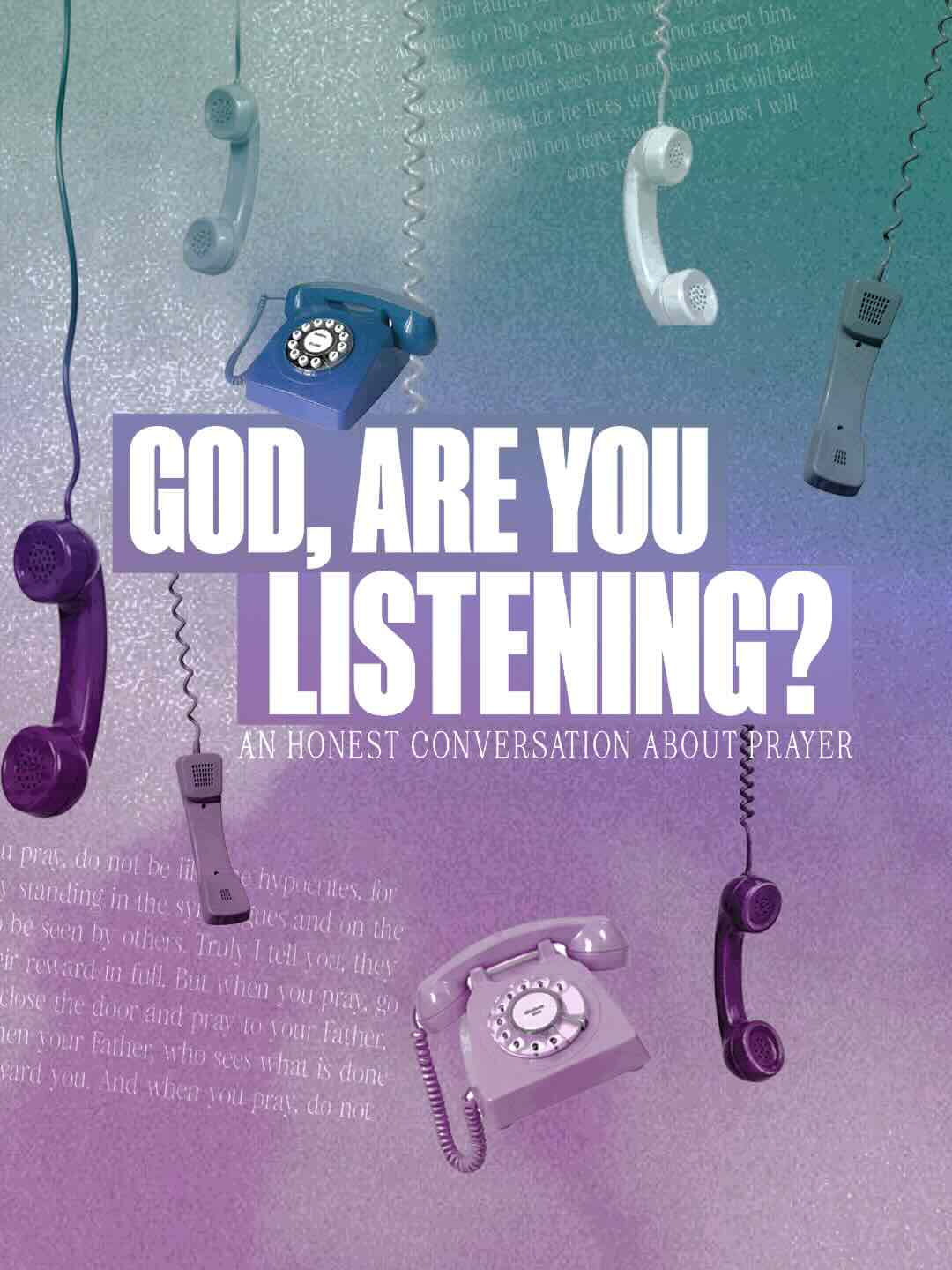
Prayer can be powerful, personal, confusing, and sometimes even frustrating. In “God, Are You Listening?”, we’re having an honest conversation about the questions many of us have when it comes to prayer. Over 6-weeks, we’ll explore how to talk with God, how to hear His voice, what happens when we pray, and how to trust Him when His answers aren’t what we hoped for or when He seems silent. Because prayer isn’t about having all the right words or all the answers; it’s about growing in relationship with a God who knows us, loves us, and invites us to keep talking with Him.